
Friday Impact Insight 4: How Do You Measure Event ROI?
If you cannot measure it, you cannot defend it.
And corporate leaders know that every investment must show value.
How do you measure the success of a corporate event?
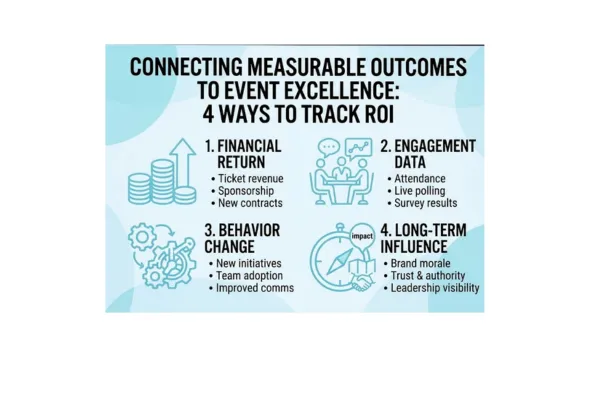
You measure event ROI by tracking financial impact, engagement data, behavior change, and long-term business influence.
Let’s make that practical.
1. Financial Return
For revenue driven events, measure:
• Ticket revenue
• Sponsorship income
• New contracts
• Sales pipeline growth
For internal events, financial impact may include:
• Improved productivity
• Reduced turnover
• Operational efficiency
ROI is not always immediate. But it is measurable.
2. Engagement Metrics
Engagement is one of the clearest indicators of event effectiveness.
Track:
• Attendance rate
• Session participation
• Live polling results
• Networking activity
• Post event surveys
High engagement signals strong alignment.
Low engagement signals disconnect.
3. Behavior Change
Did anything actually change after the event?
• Did leadership implement new initiatives?
• Did teams adopt new systems?
• Did communication improve?
Real ROI shows up in behavior.
4. Brand and Cultural Impact
Events shape perception.
Internally, they influence morale and loyalty.
Externally, they build trust and authority.
Ask:
• Did this strengthen our brand?
• Did it elevate leadership visibility?
• Did it reinforce company values?
These are powerful returns.
The Strategic Difference
The mistake most companies make is measuring after the event.
The smarter approach is designing measurement into the event from the start.
At Gatherique Events in Manchester, NH, we align every event with clear business objectives and measurable outcomes.
Because events are not expenses. They are strategic tools.
If you are planning a conference, retreat, or corporate gathering, let’s make sure it delivers measurable value.
Ready to build an event that proves its worth?
👉 https://gatheriqueevents.com/home